





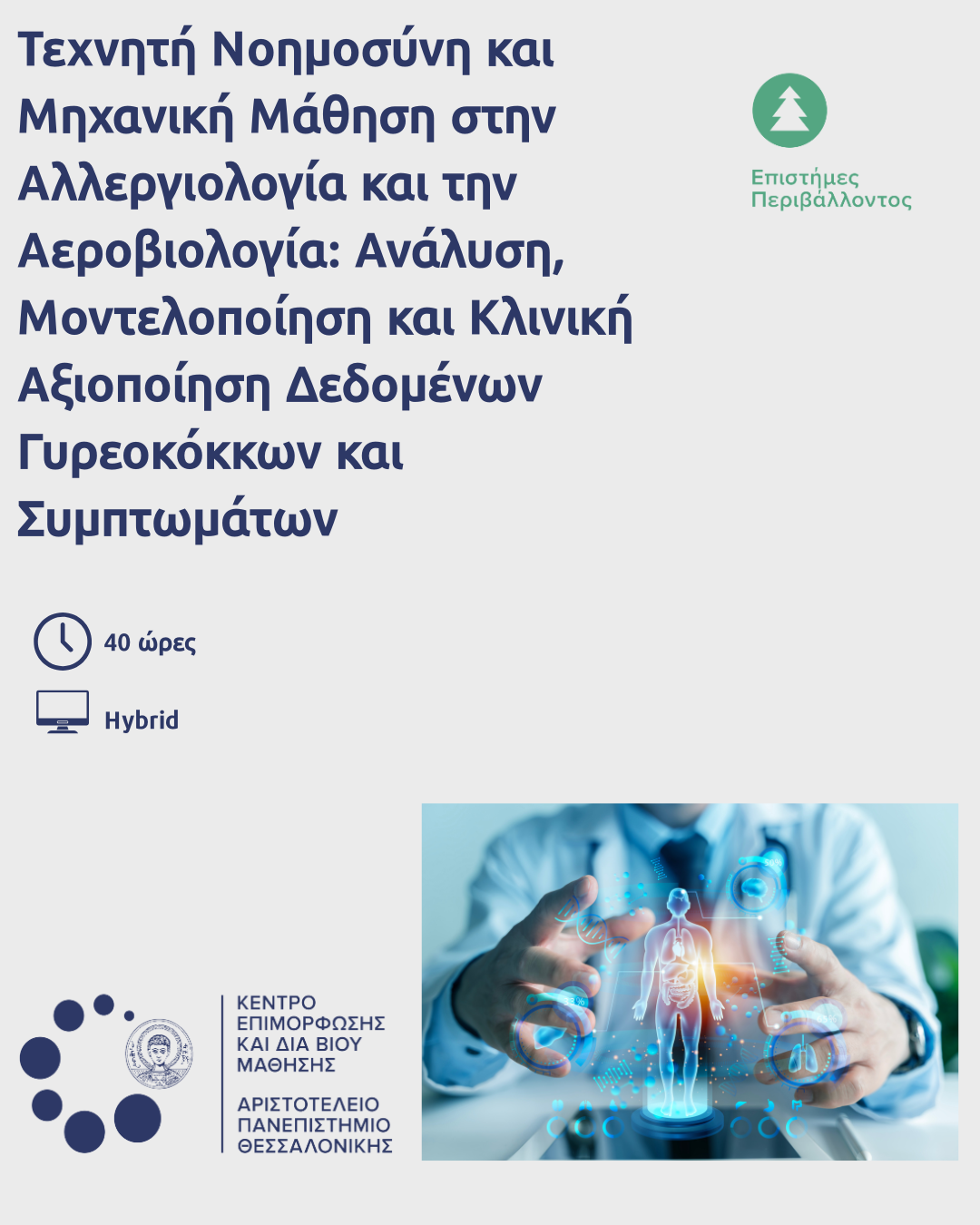
2026-06-29 - 2026-07-08 ( 40 hours )
Hybrid
Form Submission is completed on
Form Submission is completed on
For more information, interested parties can contact her/him at the contact details below.
Name: Kostas Karatzas
Phone: 2310 994176
Contact hours: Wednesday, thirsday, Friday, 10:00-14:00
Email : kkara@auth.gr
The Center for Training and Lifelong Learning (KEDIVIM) of the Aristotle University of Thessaloniki (AUTH) welcomes you to the educational program entitled
“Summer School on Artificial Intelligence and Machine Learning in Allergology and Aerobiology: Analysis, Modelling, and Clinical Applications of Pollen and Symptom Data“,
lasting 40 teaching hours, which will be held at the Faculty of Engineering, Aristotle University of Thessaloniki, and will be implemented using the method of onsite teaching with the capacity of online attendace.
The Scientific Director of the program is Prof. Kostas Karatzas
The program also involves the following lecturers
·Prof. Dr. med. Karl-Christian Bergmann, Charité, Institute of Allergology, and Fraunhofer Institute for Translational Medicine and Pharmacology, Allergology and Immunology, Berlin, Germany
·Assoc. Prof. Dr. med. Chrysanthi Sardeli, School of Medicine, Aristotle University of Thessaloniki
·Dr. Georgios Konstantinou, Chief Medical Officer, Director of the Department of Allergology and Clinical Immunology at the 424 General Military Training Hospital, Thessaloniki
·Dr. Theodosios Kassandros, MSc in Computational Physics, Aristotle University of Thessaloniki
·Dr. Evangelos Bagkis, MSc in Computational Physics, Aristotle University of Thessaloniki
·Dr. Sofia Papadogiannaki, MSc in Environmental Physics, Aristotle University of Thessaloniki
·Thomas Tasioulis, MSc in Environmental Protection and Sustainable Development, MSc in Data Science, Aristotle University of Thessaloniki
·Uwe Berger, Head of Research and Development at AZ Pollen Research GmbH, Director of the European Aeroallergen Network, Vienna, Austria
·Dr. med. univ. Markus Berger, Chairman of the Austrian Pollen Information Service, Vienna, Austria
Program start: Monday 29 June 2026
End of program: Wednesday 8 July 2026
Application start and end dates: 15 May – 15 June 2026
Duration: 40 teaching hours
Cost: 250
Installments: Yes (two)
Advance payment: Yes (50 euros)
Discount policy provided: According to KEDIVIM
A training certificate is provided of 2 ECTS
Applications are accepted from 15.05.2026-15.06.2026
Thematic areas:
·Life and Health Sciences
·Natural Sciences, Engineering and Technology
·Environmental Sciences
The programme is an innovative educational initiative that combines modern data science with aerobiology and clinical practice, focusing on the analysis, modelling and use of pollen and patient symptom data. Through theoretical lectures, case studies and AI/ML applications, participants acquire essential knowledge and skills for understanding the pollen season, investigating the relationship between aeroallergens and symptoms, and developing forecasting tools with direct clinical value.
Addressed to healthcare professionals, biologists, researchers and early-career scientists from the fields of natural sciences, health sciences and environmental sciences, the programme stands out for its interdisciplinary character, its strong practical relevance and its contribution to improving the personalised management of allergic rhinitis. The teaching team consists of professors and experienced researchers from Aristotle University of Thessaloniki and international institutions, with extensive research and publication records in the relevant subject areas. The programme is characterised by interdisciplinarity and a high degree of originality and aims to strengthen modern, high-demand skills in a rapidly developing field in which Aerobiology, Allergology, Environmental Health and Data Science increasingly converge. As aerobiological monitoring, pollen forecasting, the use of big data and AI/ML applications are gaining growing international importance for public health and the management of allergic diseases, the programme provides trainees with skills of direct professional value. At the same time, it prepares them to respond to labour market needs in the fields of health, research, environmental monitoring, digital health, and the analysis of biomedical and environmental data.
Knowledge
·They possess specialized knowledge in the fields of Data Science, Aerobiology, Allergology, and Environmental Health.
·They understand the basic principles of collecting, processing, and interpreting pollen data and patient symptom data.
·They know the fundamental principles of statistical analysis, forecasting, and applications of Artificial Intelligence and Machine Learning in biomedical and environmental data.
·They understand the importance of aerobiological monitoring for public health, clinical practice, and prevention.
Skills
·They manage, organize, and analyze data related to airborne allergens, environmental parameters, and clinical symptoms.
·They apply basic methods of statistical processing and modeling to real-world data.
·They use forecasting tools and Artificial Intelligence/Machine Learning methods to support research and applied needs with the aid of Python.
·They link scientific data with practical applications in the fields of health, research, and environmental monitoring.
Competencies
·They are able to process and to interpret environmental and symptom-oriented data.
·They are able to assess and interpret complex aerobiological and biomedical data within an interdisciplinary context.
·They are able to contribute to the design and support of forecasting, monitoring, and decision-making applications.
·They are able to work effectively in interdisciplinary environments linking health, environment, and data science.
·They are able to further develop their personal professional performance and respond to contemporary labor market demands.
The programme is addressed to:
·graduates of Medicine, Biology, Pharmacy, Nursing, Public Health and other health-related disciplines;
·graduates of Environmental Sciences, Agricultural Sciences, Biosciences, Biotechnology, Meteorology and related fields;
·graduates of natural sciences and data science with an interest in applications in health, the environment and biomedical analysis;
·researchers, PhD candidates, postdoctoral researchers and members of research groups who are active, or wish to become active, in the fields of Allergology, Aerobiology, Environmental Health, Biomedical Research and data analysis;
·healthcare professionals, scientists and staff involved in research, clinical or applied projects related to aeroallergens, environmental exposure, forecasting and public health;
·professionals who wish to upgrade their knowledge and skills in a modern, interdisciplinary and internationally developing field.
Interested parties submit an application online on the website of the Center for Training and Lifelong Learning of the Aristotle University of Thessaloniki.
Applications for participation can be submitted by anybody belonging to the targeted audience and has (a) a relevant University Degree and (b) good knowledge of the English Language (B2)
The Application must be accompanied by the following supporting documents:
1.A motivation letter
2.A CV
Prerequisites for participation in the program:
► Internet access
► Possession of personal e- mail
► Basic computer skills
Selection will be made based on priority order.
In the event that the minimum required number of trainees is not reached , KEDIVIM reserves the right to change the start date of the program or even cancel it.
Physical presence with the ability of online attendance
Teaching Module 1 (Monday 29/06): Introduction to Allergology, Aerobiology and AI/ML
This module includes a total of 8 hours of synchronous teaching.
Teaching Module 2 (Tuesday 30/06): Pollen Season Definitions and Clinical Interpretation
This module includes a total of 8 hours of synchronous teaching.
Teaching Module 3 (Monday 06/07): Quality, Processing and Integration of Pollen and Symptom Data
This module includes a total of 8 hours of synchronous teaching.
Teaching Module 4 (Tuesday 07/07): Statistical Analysis, Time Series and Modelling of the Exposure–Symptom Relationship
This module includes a total of 8 hours of synchronous teaching.
Teaching Module 5 (Wednesday 08/07): Clinical Use, Decision Support and Presentation of Assignments
This module includes a total of 7 hours of synchronous teaching, as well as 1 hour of final quiz.
Overall, the programme includes 39 hours of synchronous teaching and 1 hour of final assessment, corresponding to 40 hours in total.
Participants are provided with:
(1) Notes & slides
(2)Related linerature
A. Trainee Obligations:
B. Trainee Rights:
After successful completion of the program, participants are awarded a Certificate of Training , which is issued by the Center for Training and Lifelong Learning of the Aristotle University of Thessaloniki and signed by the President of KEDIVIM.
Participants who attended, but did not complete the entire program, have the option of being provided with a Certificate of Attendance.
Participation fee: 250 euros
Installments: 2
Advance payment: 50 euros
Μπορείτε να εγγραφείτε στο Newsletter για να μαθαίνετε πρώτοι για τα νέα προγράμματα του ΚΕΔΙΒΙΜ ΑΠΘ.